They also Died for Denmark
It had been 75 years and two days since the crash.
A small town in Denmark with an odd name housed a monument honoring a flight crew, including my husband’s uncle. Over those 75 years, no one in his family had traveled to the site. With his mother deceased and ties to that side of the family severed, Peter, as the eldest grandson, carried the responsibility of finding the grave. I hoped we could.
On August 18, 1943, three RAF Lancaster bombers were shot down over Jutland Province in Denmark. That night, EE117 of the 619th Squadron, returning from a bombing raid in Germany as part of Operation Hydra, was shot down over southern Denmark. The British lost 215 airmen in the two-night campaign against the German V-weapon program. My husband lost his uncle, a man he’d never met. Ford Thompson was one of two Canadian airmen aboard EE117.
In 1982, Danish reporter Jorgen Jorgensen reported firsthand recollections from the German night fighter pilot Oberleutnant Hans Meisner, who was responsible for downing the three Lancasters that night. We discovered Jorgensen’s article in 2015 and, after further Internet searches, located the crash site and the crew's final resting place. Our pilgrimage was on.
Copenhagen greeted us with a cool, rainy day—not unlike Vancouver in April. Weather aside, we went through an efficient car rental process, picked up our Volvo, and headed downtown to spend the night in the city before heading out to the provinces. Since neither of us spoke Danish, we would rely heavily on Google Translate.
That evening, we stretched our legs and explored Copenhagen. Surrounded by extremely attractive blonde people, we ate goulash and drank Danish beer at a sidewalk café, enjoying the warmth from the heaters. Our server told us that English would soon be compulsory for all Danish children. We’ve got this. That reassured us, and our confidence in our ability to communicate in the Danish countryside grew. We spent the night at the Copenhagen Plaza, and since we both agreed that little in the world beats a good Euro breakfast buffet, in the morning we’d fortify ourselves for the journey ahead.
Peter, the organized traveler that he is, had all the location coordinates and town names ready for me, the navigator, as we left the city and headed to Ustrup. Leaving the capital region, we crossed the massive suspension bridge spanning the Great Belt Straight and headed into Jutland Province.
About three hours later, after much deciphering on Google Maps, we exited the highway for Ustrup. Turning right, we drove up a small berm and around a bend. The next sign indicated we had left Ustrup. “Wait. What? That was Ustrup?” We had only driven 300 meters. It was clear there was very little in Ustrup. Not even a church. But there were a couple of thatched-roof cottages, and on what must have been our third pass up the berm and around the bend, we approached one of the hobbit houses and spoke to a lovely gentleman, who, after we had explained our mission, exclaimed in perfect English, “Oh, you must mean the other Ustrup.” Perhaps this is like St. John’s and Saint John? Maybe Canadians are not the only ones who play tricks with names.
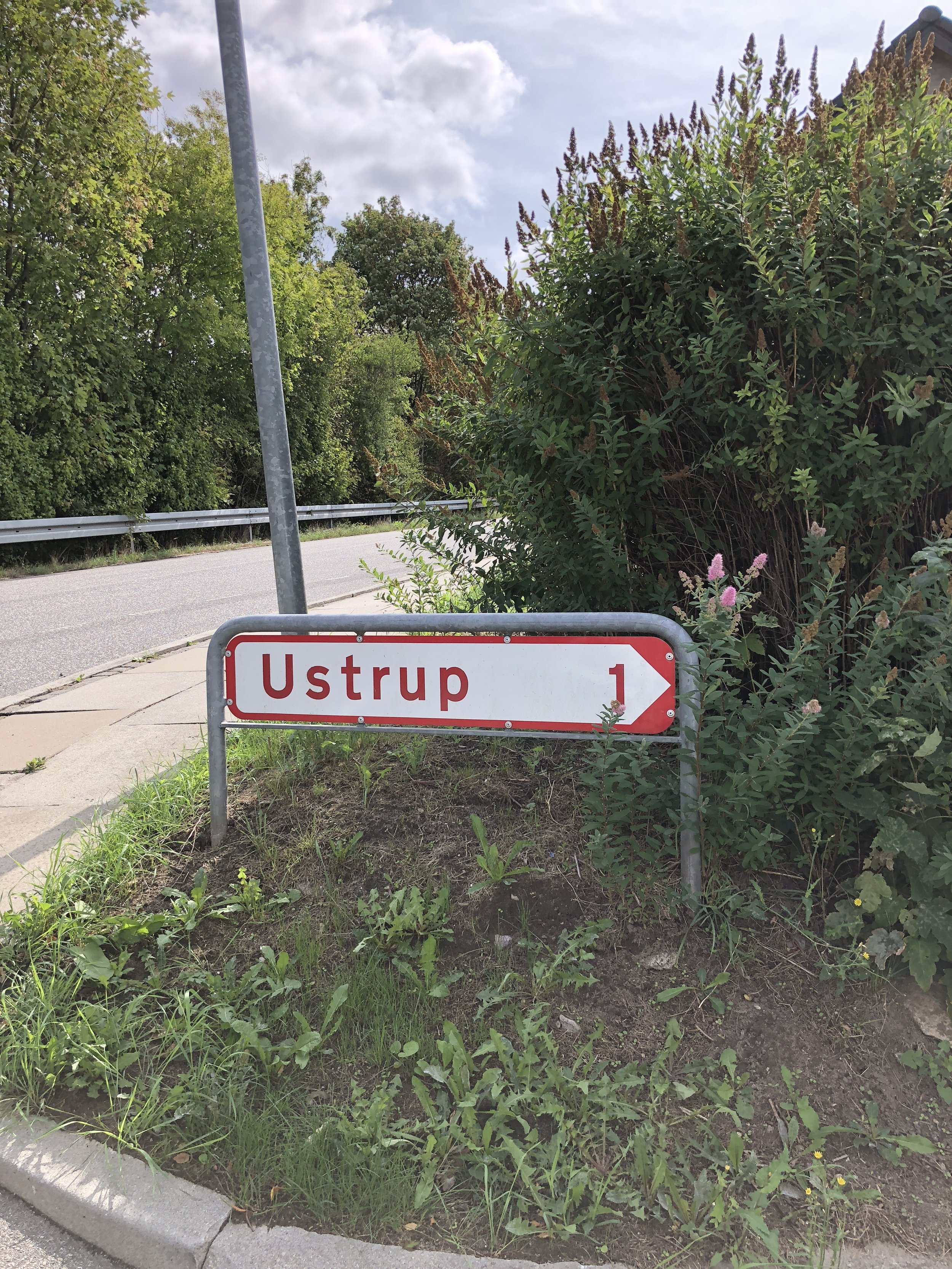
One of the Ustrups
Denmark proper—excluding Greenland and the Faroe Islands—has a landmass smaller than Nova Scotia. How could there be another Ustrup? We turned to Google Maps and discovered we were in Ustrup Hylke, but we needed to be in Ustrup Vojens, about 116 km south. Of course! Ustrup Vojens. Who knew?
Upon arriving in Ustrup Vojens, we were pleased to see a village slightly larger than Ustrup Hylke, though not by much, with a school and a church. After several passes through the village, our spirits flagging, we spotted a small white sign with faded red lettering that read “RAF.” Following the sign's direction, we drove down a private drive and entered an expansive courtyard with a farmhouse and a barn. Concerned about trespassing, we approached a couple and their dogs in the yard, all of them curiously eyeballing us. The dogs seemed to understand the international command “stay.” We were in luck; language would not be a problem.
After introducing ourselves as Canadians on a family mission and explaining what we were looking for, we asked whether the weathered marker at the end of the road was the sign for the Royal Air Force crash site. It most certainly was. They pointed us toward a rutted pathway.
Twenty-five meters to our left, shrouded by trees, stood an engraved boulder memorializing the eight souls lost that August night in 1943. We had found the crash site. Standing on hallowed ground under a clear blue sky, we imagined the horror of the fight that night many years earlier. Reflecting on the beauty of the lush pastoral setting that only time can bring, both of us, in private thought, envisioned the deep scar where debris would have scorched the earth as the plane tumbled in a burning fireball, leaving nothing behind but memories of loved ones for the families left to mourn. In a final goodbye, we ran our hands over the engraved names with urgency, seeking the cemetery where the crew was buried.
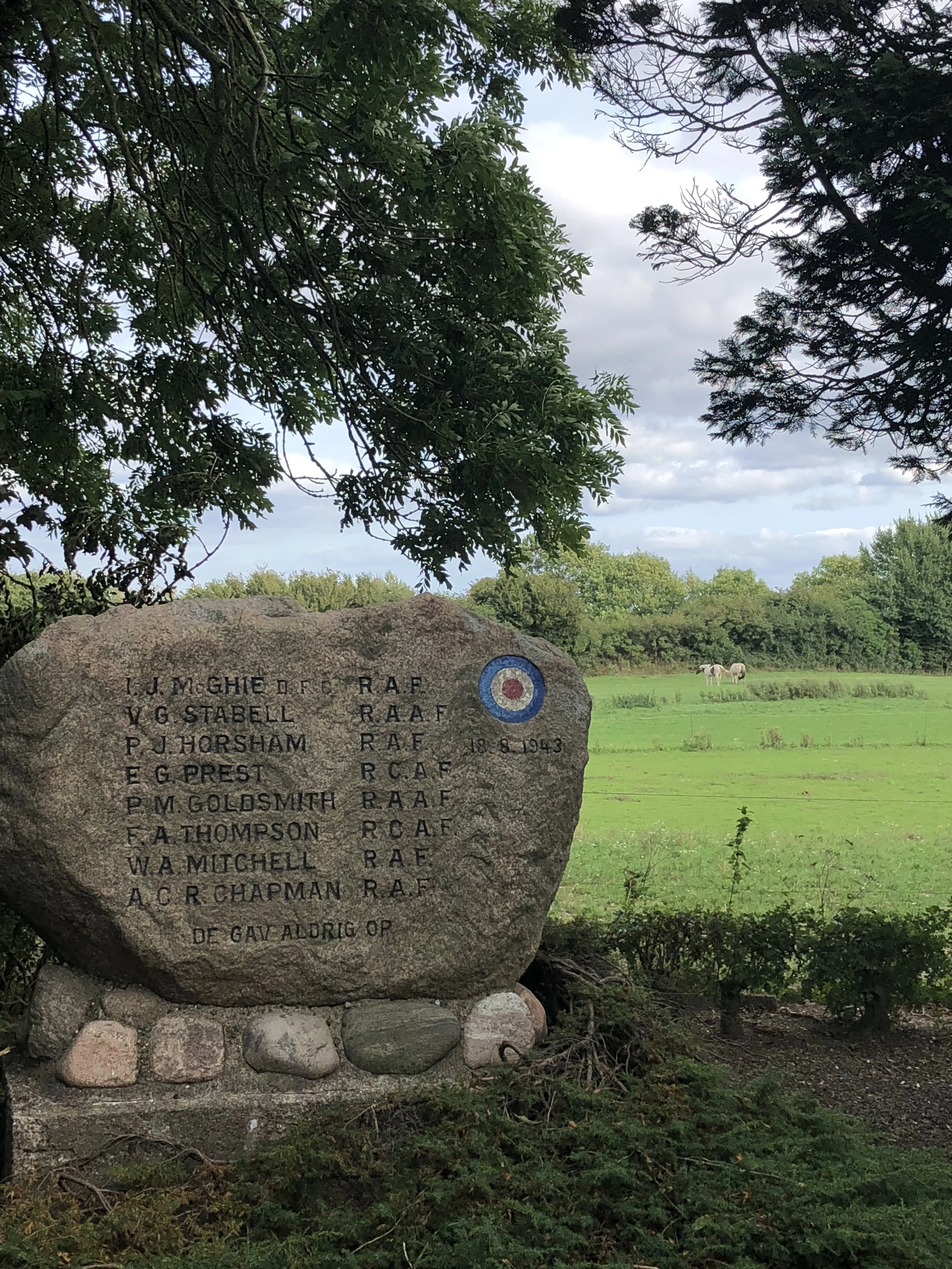
Crash site
After thanking the property owners for their assistance, we mapped the route to Aabanraa, 10 km north of Ustrup, which we believed was the burial site. With a population of 15,000, Aabanraa was larger than both Ustrups combined and warranted two highway exits. We were back on the road.
Google Maps was not entirely cooperative—or perhaps it was a navigation error—but after several loops around Aabanraa and failed attempts to locate the cemetery, we agreed the best way to find a cemetery was to find a funeral home. Initially, the funeral director was suspicious about why these two English-speaking strangers were looking for the cemetery, but after we explained our quest, he was delighted to help redirect us to the town center.
After successfully locating our destination, we parked the car and walked along avenues of trees and neatly groomed hedges, unsure where the graves were. Late in the afternoon, the sun warmed the air, cleared of the morning’s drizzle, bringing the vibrant pink impatiens and lush hosta to life along the walkways leading to the interior. Reverent and somber in our approach, yet excited about what lay ahead, we anticipated a lonesome marker or a neglected patch of grass.
But there they were. Rows and rows of simple headstones, each engraved with the name, rank, and country of origin, and a message of faith and love: He is not dead / He is just away / Dearly loved and sadly missed by his family. We were awestruck! The Commonwealth War Graves Commission maintains the memorial to the Brits, Aussies, Kiwis, and Canadians. An eight-foot-high memorial stone stands there, with an embossed angelic image that watches, protects, and never forgets those who died for Denmark. The stone is engraved with the words: Remembering the 138 Allied airmen / They also died for Denmark.
Seventy-five years later, my husband honored his uncle, buried 6,500 km from home. But Uncle Ford was not alone. Surrounded by the love of the Danes, he was with the other fallen airmen who had shared his courage, fear and love of country. They were now his family.
Both journeys were complete.